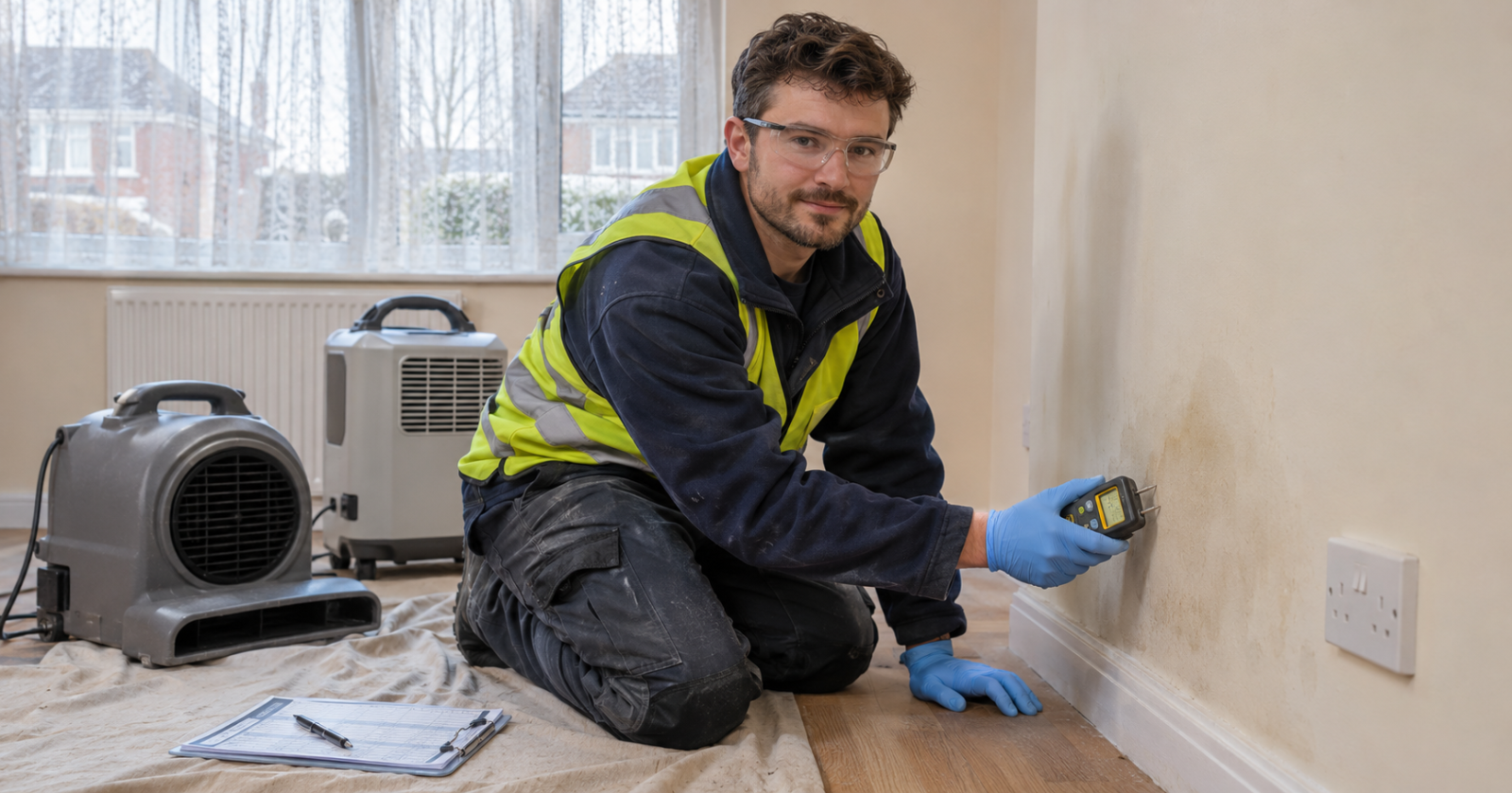
Drying slows in winter for a simple reason: cold air holds far less water vapour than warm air. When water losses occur during the colder months, practitioners often find that equipment which performed well in summer now takes longer to bring structures back to target moisture levels. Understanding the psychrometrics behind this is the first step to adjusting your approach.
Why Cold Air Slows Drying
Air can only carry a finite amount of water vapour, and that limit falls sharply as temperature drops. Cold air therefore reaches saturation with much less moisture in it. Two consequences follow for drying:
- Relative humidity rises quickly. A parcel of air at the same moisture content can read near saturation when it cools, even though it has not gained any water.
- The vapour pressure difference that drives evaporation shrinks. Drying depends on the gap between the vapour pressure at the material surface and that in the surrounding air. When the air is cold and humid, that gap narrows and moisture leaves wet materials more slowly.
Cold surfaces compound the problem. Walls, floors and subfloor voids in unheated properties may sit close to the dew point of the air, so condensation can form on them rather than moisture evaporating away.
Interpreting Your Readings
Relative humidity on its own can mislead. A reading of 70 per cent in a cold room may represent less moisture than 50 per cent in a warm one. Instead, practitioners should work with:
- Dry bulb and wet bulb temperatures, from which dew point and moisture content can be calculated or read from a psychrometric chart.
- Dew point compared with material surface temperature. If surfaces sit at or below dew point, condensation and surface wetting will continue.
- Moisture content of the air, expressed as grains per pound or grams per kilogram, which shows whether the air can still accept moisture from materials.
- Material readings over time, not single snapshots. A flat or slow trend in moisture content, with ambient conditions unchanged, is a signal to reassess the drying plan.
Use a meter you understand and have checked against known references, and record ambient and material readings together so trends can be compared from day to day.
How to Adjust Your Drying Approach
Winter drying usually needs a different plan, not just more equipment. Consider these adjustments:
- Heat the air, not just the room. Warming the air raises its capacity to hold moisture and improves evaporation, but avoid overheating, which can damage finishes or make conditions uncomfortable for occupants.
- Select dehumidification suited to low temperatures. Refrigerant dehumidifiers become less effective as air temperature falls, so desiccant units are often considered in cold conditions. Always check manufacturer guidance on operating ranges.
- Be cautious with ventilation. Opening the property to cold outside air can introduce moisture while lowering temperature, so ventilation decisions should be based on vapour pressure and dew point comparisons rather than instinct.
- Control moisture at source. Make sure any remaining water entry, leaking pipework or wet building elements are dealt with before expecting drying curves to behave as planned.
- Protect occupants and other materials. Cool, damp conditions raise the risk of mould growth, particularly where drying is slow, so monitor surfaces and keep customers informed of progress and risks.
- Set realistic timescales. Build winter drying programmes with longer expected durations and communicate this clearly to insurers and customers.
Why This Matters for Field Teams and Claims Handlers
Winter losses often need extended monitoring and clear reporting. Field teams who can explain why readings have slowed, and what they have changed in response, give claims handlers and insurers a defensible record. Office based staff benefit from understanding these principles too, because they shape timescales, costs and customer expectations.
Build the Skills Before the Next Winter Loss
Our Water Damage Restoration Advanced course is designed for field based practitioners, including insurance professionals and surveyors, who manage the mitigation and drying of water damaged buildings. It covers the science of water and materials, moisture assessment, psychrometrics and restorative drying. The next delivery runs online on 4 to 5 February 2027. Find out more on the course page.